Thursday, October 23, 2008

Isle of Skye, Scotland


Portree

It was quite easy to find places to free camp on the Isle of Skye. It was quiet at this time of the year but with a bridge joining it to the mainland now it is a busy place in the summer.
There are lots of walks on the island in the national parks. This one is very popular but it was too wet and windy to enjoy walking. We did see several cyclists struggling against the elements.
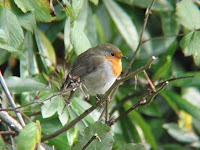
The first robin we have seen.
Visited Dunvegan Castle belonging to the Mac Leods.
While on Skye it was John's mother's birthday so we phoned her to wish her happy 95th. She said she couldn't believe she was 95!

Western Isles Road-Ullapool to Skye, Scotland


What a beautiful part of the country.

We stopped at this wee place called Plockton and the main street was lined with NZ cabbage trees. Most people over here think they are palm trees but the cordylines are actually the world's largets lillies!

Wednesday, October 22, 2008

Lewis, Outer Hebrides, Scotland


Lewis Island has a lot more things for visitors to do and see.
We visited the Blackhouse Village of Gearrannan on the coast. We could only see the outside of the houses as they had closed for the season. People were living in the houses until the late 60s when the government built council housing for them just down the road. They have been renovated and one of the buildings is a youth hostel while others are shops.
The newspapers here have many stories that say that Great Britain is in a recession following the collapse of several banks. We have found places closed that our guide books say are open all year round. I think they believe there is a recession so they don't stay open!
Further around the island we found the Arnol Blackhouse and were able to go inside it and learn about what it was like to live in a stone house. There was a peat fire smouldering away in the centre of the house and the smoke found its way out of the roof as there was no chimney. A chain and hook hung from the ceiling to hold the cooking pots. The peat had a lovely sweet smell.
There were typically three rooms. The first room was the entry in the centre of the building and the chickens were housed here. At one end was the peat fire with bench seats on two sides. The cooking, eating,dancing and socialising took place here. The bedrooms were box beds built into the wooden walls with curtains for privacy.
At the opposite end of the building were the stables where the cows, sheep, horses and goats were housed. I'm sure no one was a light sleeper in these places.
There are several places where there are standing stones or stone circles similar to those at Stonehenge. These were at Callinish and were discovered when someone was digging the peat that covered them. There were many theories as to what they were used for but probably pagan rituals or worship places.
Stornoway, the largest city on the island was a welcome sight at the end of our island visit. It had so many trees and gardens and was full of colour. We arrived on a Sunday and all the shops were closed and there were not many people about. The islanders are very religious here and observe Sunday as the rest day. We happened upon a petrol station that was open so were able to get some supplies. There were queues out the door and into the rain.
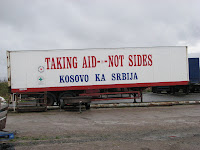
We saw this trailer outside the petrol station waiting to go on the ferry to the mainland with aid supplies for Kososvo.

South Harris, Outer Hebrides, Scotland


Many of the smaller islands are joined by causeways. Unfortunately we didn't get to see any otters crossing but we did see a few seals in the kelp beds.

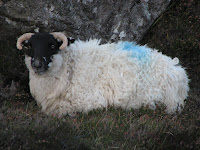
Even the poor sheep were finding the cold and wind difficult to cope with and found shelter where ever they could. There are several knitwear factories that make the famous tweed wool cloth from these sheep. These horned sheep have right of way on the roads here.


South Harris is the rockiest place I have ever seen so there were not many places where peat could be harvested but there were many pools and lakes amongst the rooks.

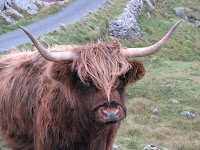
This Highland cow found the grass around our camp spot delicious and came back several times to see us.


It was hard to make out the houses in the rocks as they just blended into the rocks.

Erskay & Benbecula Isles, Outer Hebrides, Scotland


Autumn is a great time to see the leaves changing colour but it is not so good for sightseeing. It has been damp and cold.


The Islanders mostly fish, farm sheep and goats, dig peat and make hay while the sun shines. This Crofter's house is typical of many on the islands. The end walls have the chimney built in to them. The front door and windows are as I would have drawn them as a young child. Today many of the houses have slate rooves or corrugated iron rooves rather than the traditional thatch like this one.


There are many marine farms in the sea and fresh water lochs and many stock salmon. An island delicacy is peat smoke-cured salmon.

There are very few trees about but lots of bracken ferns, heather, and rocks.


We trudged out in the wet and wind to visit an archaeological site at Hallam. The three circles of rocks we saw were the foundations of of houses dating from 1000BC. One of the houses had
the remains of a bronze foundry and they also found skeletons buried in parts of the houses.


We continued onto North Uist which had lovely sandy beaches. The weather held long enough for us to do a walk in the wind along the coast.


Wednesday, October 15, 2008

Barra Island, Outer Hebrides, Scotland

Drove to Oban and bought a 'Hopscotch' ferry ticket with Caledonian MacBrayne. The ticket covers a set route and is valid for one month.It was cheaper to buy it that way rather than individual tickets. There was another set route option but it was only for 8 days. Luckily we had the Hopscotch ticket as the first ferry crossing we had booked for Oban to Barra was cancelled.

The weather in Oban was really nice and we camped beside the sea at an enormous camp site. It has heated bathrooms which were so nice on a cold morning. There were not many people about as the weather at this time of the year is cold, wet and sometimes misty. I think we were the youngest in the campsite. Up until now we have been the oldest in the hostels we have stayed at so that makes a pleasant change to be the youngest!
Oban
Our friends Ereti and Wallace gave us lots of warm clothes so we have been lucky as we would never have survived the cold wet days otherwise. We had planned to visit the Charity shops to buy some secondhand winter clothes but Ereti had loads of clothes we could have. She could start her own charity shop.

The ferry crossing to Barra Island was very smooth. There were not many people on the boat and most of them stretched out on the couches and went to sleep. There was a disinfectant- smelling area especially for the dogs and their owners next to our lounge area. Brits really love their dogs and take them everywhere.

We need to telephone people we want to visit so we have finally bought a cheap cellphone to do that. It has been difficult finding coin telephones or places to buy cards for the card phones so after leaving home and wanting to be 'low-tech' we have now found it necessary to have the computer and cellphone!

We have been able to text our daughter Kerri who has just headed off to South America for a 10 day tour. She had the chance to take the familiarisation trip as part of her work as a travel agent.


The Caravan Club guide book we have doesn't list many campsites in the Outer Hebrides so we visited a tourist office who told us we could free-camp where ever there were parking signs. Places where overnight camping was not allowed were signed as such.

The leaves on the trees are turning the glorious autumn tones.


All the street signs are in English and Gaelic and the Outer Hebrides (named by the Vikings) are also called the Western Isles or Na h-Eileanan an Lar! Half of the Gaelic speaking Scots live on the islands so you can hear Gaelic spoken often.


Barra is pretty small so were able to drive around it in no time at all. It is windswept and peaty. The roads are one laned and have lots of bays for passing so there is no way you can race along. The island is joined to Eriskay Island by a causeway.

Monday, October 13, 2008

Dunhill Links Championship, St Andrews, Scotland

As luck would have it while we stayed with Ereti and Wallace, John spotted a poster advertising the Alfred Dunhill Links Championship, being played a short distance down the road over three course, Carnoustie, Kingsbarns and the Old Course at St Andrews - and the first three days had free entry and free car parking. This was most unexpected in Scotland and anywhere in the UK where car parking usually costs a week's wages!
He got on the web to see who was playing on which course when and to check out the weather and so we went to St Andrews to watch the second day's play. The golfers played three different courses with the final round at St Andrews.

The wind was very strong but it did not rain! The previous day it had taken the players seven hours to complete 18 holes. The event was played as a pro / am - a pair of pros with a couple of celebrities in each group. One of the amateurs was an 85 year old from Canada who was still playing off 15.

Followed Michael Campbell for a while. he had a pretty good tournament with three good rounds and the usual blow out of 77 on the third day in atrocious conditions - he ended up five shots behind the winner, Karlson. At least he made the cut!
Montgomerie

Also followed Colin Montgomerie, Ernie Els, Paul Casey, Jimenez, Thomas Bjorn, Darren Clarke, Lee Westwood and Paul McGinley.
Els

All of the amateurs were pretty handy with a club. The best we saw was probably tennis player Tim Henman who was getting better distance than some of the pros. In the field we saw Olympic rower Steve Redgrave ( National hero over here for winning five gold medals ), Franz Klammer, Hugh Grant, Johan Cruyff, Shaun Pollock, Ian Botham and Shane Warne ( smoking a large cigar but not phoning or texting any women as mobiles were banned from the course ).

John was only able to take a few photos until he discovered that no unofficial photography was allowed on the course.

We were able to spend a lot of time in the grandstand on the 18th.


There was this little stone bridge in the middle of the 18th!