Monday, November 3, 2008

Galway, Republic of Ireland


Traveling at this time of the year is quite difficult. Many tourist venues are closed for the season and so are campgrounds. We have found signs to campgrounds and when we travel the 12 or so kms to them we find that they are closed. We even arrived at one place as it was getting dark. There was no one at reception so we made ourselves at home. In the morning we wanted to shower but there was no one about so we could not get tokens to start the showers. When we were ready to leave there was still no one about so we just left.

It is also difficult trying to find places to park overnight. People build stone walls close to the road and there is no place to park. Some people build a recess for the gateway and may have a small section to park their visitors cars so it is not suitable for us to stop there either. We have found a couple of gravel dumps to camp in and so far haven't been woken by graders or workers.

We had to do some running repairs on our van as the sump cover rattled a couple of bolts loose and a garage worker kindly let us help ourselves to his nuts and bolts. John was able to fix it with the small set of tools we had on board.

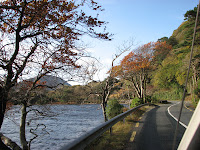


Stopped for lunch at the Connemara National Park. The weather cleared and it was quite pleasant. The visitor's centre was closed though.

In the middle of nowhere was the Kylemore Abbey. We read that it was used as a boarding school now. It was originally built by Quakers.

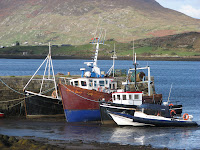
There were many small villages with mussel and salmon farms.
The leaves are falling now and there are many trees with berries. There were some huge holly trees along the roadside.


Many people say that Ireland is a lot like New Zealand. Certainly some parts are like parts of the South Island but we haven't see much that looks like where we live in the Bay of Plenty. This scene of gorse and flax reminded me of NZ though.


We followed the narrow coast roads through the small villages and saw this castle at Slyne Head.

Donegal, Republic of Ireland


We camped outside Derry where the hedge in the camp marked the border with the Republic of Ireland. When we woke in the morning we saw the hills in Donegal covered with a sprinkling of snow. We had heard on the radio that the overnight temperature was -4 Celsius.

We headed north and all around the coastline of the Inishowen Peninsula. the roads were pretty narrow but the drivers are very considerate.

This dog thought he was in for some treats as he watched us eating our lunch.

Donegal town is much smaller than we thought it would be with a population of 2450.

We managed to find a tourist office open here and asked for a campground. The receptionist told us that there were some unregistered sites but she wasn't allowed to give us any information on them but we were welcome to camp in the car park behind the building for free. She tried to find us a place to have a shower but the hotels did not want us there and the local leisure centre wanted to charge us 30 Euros.


In the evening the main square in Donegal was bustling with teenagers dressed for Halloween.

We moved onto Sligo which was very pretty.


We drove through the Doolough Valley. In 1849, in icy weather 400 people died as they walked along the road from Louisburgh to Delphi and back. They were hoping to get food and help from a landlord but were refused.


Later we passed the Aasleagh Falls.


Londonderry, Northern Ireland


We continued along the coast and onto Londonderry. Signs in Northern Ireland point to Londonderry but signs in the Republic point to Derry.

Derry/Londonderry is a walled city. The wall was started in 1545 and completed in 1619. There are still some old cannons along the walls and the name Derry comes from the fact that the walls have never been breached by invaders.

On the west of the walls is the Bogside district which was developed in the 19th and early 20th centuries as a working class mostly Catholic residential area. It was the place of the three-day 'Battle of the Bogside' in August 1969. Today it is still residential and the buildings have murals commemorating key events in the Troubles.


We visited Ereti's son Jason at Duncreggan University. He is studying music with an interest in composing. He was thrilled we were able to bring him some things he needed from home.

Portrush, Northern Island


My sister's partner's parents live in Portrush so we visited them. Portrush is pretty busy in the summer with holiday makers arriving to spend time at the beach. It is popular for surfing as well and there were quite a few brave souls in the high seas trying to catch waves.

The port was a place where many Irish folk left by boats for America during the Potato Famine.
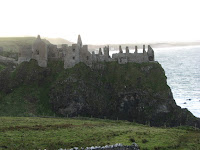
We drove around the coast and saw the ruins of Dunluce Castle. Part of the castle, including the kitchen, fell into the ocean in 1639, along with some of the servants and the dinner. It was owned by the Mac Donnell family too.

There are several international golf courses along the coast line in Portrush. It would have been nice to play a game but it was very wet and windy most of the time.

Gerry and Kathleen made us most welcome. Gerry is a retired plumber but still does odd jobs about the town. Kathleen does volunteer work at a charity shop and had been asked to sell poppies to raise funds for war veterans.

Stranraer, Scotland to Islandmagee, Ireland

Our friends Alan and Helen put us in touch with friends of theirs, Stephanie and Matthew, near Stranraer. It was really convenient as it was not too far from the ferry crossing to Northern Ireland. Matthew and Stephanie live on a large farm and are pretty self-sufficient. We ate sausage they had made from their animals. Matthew had a duck and some pheasants hanging outside the back door ready to be prepared for eating.

The property that they lived in used to be the local parish school and it was interesting to read an account from one of the teachers who ran the school. She had several children arrive at the school during the war years and they were billeted by local farming families. Unfortunately we didn't get any photos of our stay with Matthew and Stephanie.

We headed off early the next morning and found our catamaran ferry had been cancelled because of damage it had sustained in a storm the day before. We had to wait several hours before the next ferry crossing and they took a long time to load as they had lots of extra passengers. It looked to us like they would never fit everyone on but they did.

Our tourist information pamphlets showed us a campground not far from Belfast so we decided to cross the city and have a brief look at it but it turned out to be the wrong decision as there were several streets being resealed and car crashes and ambulances blocking up the one way streets. When we finally arrived at the campground it was closed so we continued driving along the coast looking for somewhere to camp.

We found a caravan club site at Islandmagee and were the only people in the camp even though it is mid term holidays for many schools. It was very cold so we were grateful to be able to plug into the electricity and have our fan heater running. The camp was pretty basic and had no showers or hot water and we had to walk a long way to get to the toilets.

We drove around the peninsula and spent some time talking to the local fishermen near the bird nesting colony at Port Muck. We were hoping to be able to see some puffins but they had headed for Rathlin Island further off the coast. If the weather had been better we would have liked to have spent some time on the island but it has been stormy lately.

We continued on around the coast road stopping briefly in Glenarm, the home to the Mac Donnell clan.

We arrived at the Giant's Causeway during a break in the weather. The fee to park in the National Trust car park was 7.50 Euros for our van and a man told us to continue driving to the hotel car park where we could park for free if we had a cup of tea there. The tea only cost 2 Euros. There were still several tourists clambering over the rocks even with the high seas running. Parts of the walkway were closed due to land slides.

Thursday, October 23, 2008

Scone, Perthsire, Scotland

Drove through Fort William and Glen Coe back to Scone. The weather was miserably wet and miserable.
We spent more time with our friends Ereti and Wallace again. John was able to go and play golf in the rain with Wallace and Lil was able to help Ereti with the cooking. Wallace was very proud of his enormous leek which we used to make a tasty leek and potato soup with.
Wallace's sister and her husband also stayed so each evening we had fun playing charades again.
John was able to help out doing some jobs about the house and we have loaded a suitcase of Ereti's son's clothes into our van and are heading for Ireland.

Glenfinnan, Scotland

Our friends Helen and Alan from Balcombe, Sussex put us in touch with their friend Alistair in Glenfinnan so we paid him a visit.


We enjoyed the 'stalkers' pie' Alistair made from venison and topped with potatoes.

He lives nearby this viaduct that was used in the 'Harry Potter' film.


Alistair works as a gamekeeper and forester on the Glenfinnan Estate. He had guests arrive while we were visiting and they were preparing to shoot stags (red deer) on the Monday and then hinds on the Tuesday. Each year the estate culls 30 stags and 150 hinds.


Alistair has a busy life involved with managing the local rugby team, deerstalkers' ball, and is a local sherriff (Justice of the Peace).


Not far from the house is a statue to the 'Raising of the Standard'. It was here that Bonny Prince Charlie made a move to be king in 1745.