Amran is situated on a small hill with a citadel above. The city marks the border between the tribal and government run areas. It lies on the old Frankincense trading route. Today there is a huge modern city on the outside of the old city. A lot of the modern buildings are government offices and military buildings.
The old city is surrounded by a high wall and the buildings inside it are all adobe.
The local children were pretty excitable and some were aggressive - snatching at the books we had in our hands and grabbing our arms and clothing. Some of the young ones surrounded Vic begging to have photos taken and then all scrambling to be in the shot. Some of the locals reprimanded the kids and others chased them away when they saw them crowding us.
It was qat chewing time when we arrived so there were very few shops open and the old souq was closed so we didn't spend too much time there.
Our next stop was Thilla ( Thulla ). On the way here we passed many poultry rearing sheds as well as the usual crops of wheat and maize.
Thilla is a UNESCO listed site, with about 8,000 people living inside the old city walls and 4,000 outside. There are 25 mosques in the old city. There were a large number of young men on well-polished and decorated motorbikes. They were
recklessly driving fast through the narrow streets. Probably they are the rewards of growing qat in this fertile valley.
The adobe houses had alabaster windows to let light in and afford privacy for the women. Some whitewashed the window frames to make them a feature and to add interest to the houses that would otherwise have melded into the same coloured hillside.
We were met by a couple of local guides who also happened to own souvenir shops. They pointed out the houses that were built by Jewish families with their coloured windows in the shape of the Star of David. There were also houses with the Maltese cross.
The streets were clean and tidy even though some animals were stabled on the ground floor.
The main water cistern had been emptied as it was leaking and now they have to wait for the summer rains to refill it.
We had a speedy trip back to San'a where we were able to burn a CD of the photos from our camera and Vic's one too. We need to look for a replacement camera to record the final month of our travels.
The children were asleep when we got back to Victor and Asia's place and we were disappointed that we had missed seeing them.
Saturday, May 9, 2009
Shaharah, Yemen
We headed into the old city to meet our tour guide for a trip to Shaharah. We travelled in a 4x4 vehicle and were joined by Vic from Austria. The tour did not start well as the young driver / guide forgot to copy the travel permits so were turned back by the police at the first checkpoint and had to hang around for an hour or so. None of us were impressed by his loud wailing music either as we couldn't talk to each other.


Since 2003 North Yemen has a group of fighters who are anti-government. They feel the government is too pro-western. These two groups battle from time to time so the police escort was necessary for us. There have been several incidents of kidnapping of foreigners.
This part of the country is under the control of tribal leaders or sheiks. Victor tells us that the people who are kidnapped are treated like kings as the tribes want to draw international attention to their issues.
We stopped at a village restaurant for lunch and got to meet the Russian group and their guide from Uzbekistan. At lunch we learned we had to pay for the escort group as well as their qat and their lunch. For lunch we had mutton broth soup, cabbage salad, salta- a meat stew with lentils, spices and fenugreek. We had no cutlery and had to use the flat bread to scoop everything up in order to eat it. This was followed by very very sweet black mint tea.
We arrived at a small village in a Bedouin area and had to pick up a Bedouin guide as well. The Bedouin would not allow our 4x4 vehicle to continue up the steep mountain road to Shaharah so we had to have another driver and a wreck of a 4x4 vehicle to continue our journey.
The steep road to the village above the valley was dusty, rocky and bumpy. John and the guide sat on the back while Vic and I were inside. About one kilometre from the top of the mountain and the village of Shaharah the road was blocked with workmen repairing it so we had to turn back and travel back into the valley. We took a badly maintained road and it was worse than the first one.
The village was a fortified place 2,600 metres high. At the village we stayed in one of the three tourist hotels. There were mattresses on the carpeted floor, a hot water heater and shower, squat toilet, and a large common room where we ate dinner. The electricity went off for a short time but there was a back up generator.
We sat on the floor and ate a dinner of bread, beans, rice and egg omelette. The Uzbekistan guide played the urd and sang some traditional songs. After dinner we had a warm lemon-flavoured non-alcoholic beer, a warm shower and an early night.
The next morning we had bread, boiled egg and a spreadable cheese breakfast followed by sweet black tea and headed of to look around the village. There were two open water cisterns where veiled women were filling buckets of algae-green water and taking them on their heads back to their houses.

Some of the local children joined us and pointed out the mosques, local school, and prison. Sometimes we were crowded by children begging for pens, to have their photo taken, and money , of course. 46% of Yemen's population is under 15 years of age and women have an average of 6.5 children. 73% of the population live in rural areas. According to UN stats, 45% of the people live below the poverty line of $2US per day and only 50% are literate. So, there are children everywhere eager to follow you and try their luck.
Outside the village is a stone bridge that is 340 years old. It has helped link the villages on each side of the gorge after centuries of being apart.
The walk downhill was meant to take 2 hours but the photo-snapping Russians and their unfit guide meant we took 3 and a half hours. Unfortunately for us our camera decided to pack up during the trip so we used our memory card in Vic's camera.


The walk down went through the qat terraces. The valley and the numerous ranges around it were pretty dramatic.
We dropped our Bedouin guide off at his village and headed with the police escort from there out of the area. We passed lots of young men with knives and guns and we saw a couple of burnt out armoured cars rusting away in the valley. Some young men threw stones and sticks at our vehicle but none made contact.
Once out of the valley we were back on the sealed road and headed for Amran where the police said their goodbyes.


Friday, May 8, 2009
Manakhan, Yemen
We had an early morning with Victor and the children and his friend Hussein drove us to the Haraz Mountains.
Along the highways are asphalt speed bumps covering water pipes that cross the road or just heaps of earth piled up to slow traffic. This is where veiled women in black sit begging, children try to peddle tiny apricot or peaches, and boys shake their plastic bags of bundled up qat for sale at the vehicle drivers.
We passed several police checkpoints, and had to hand over our travel permits. We got the permits from the tourist police in San'a for no charge and had to have several copies made to hand out at each checkpoint. The permits listed the days we would travel and our destinations.
At the first checkpoint, the police asked where we were from and where we were staying, they next asked for a pen. Victor told them we were staying with him. When he told them his name was Victor they didn't believe he was Yemeni as Victor is not a Yemeni nor a Muslim name. We had to pull over at every checkpoint as they phoned the station and checked his ID. They were not interested in us at all. Victor's dad studied in Germany and named Victor after a good German friend. Victor is the only Yemeni called Victor and get hassled often about his name.
Some of the villages we passed through were called souqs and they were a few steel buildings selling all the same things. There were small pick-ups parked in the narrow streets from the back of which men sold their bags of qat. They outnumbered the shops. The dusty streets were ankle deep in plastic bags and rubbish. There doesn't seem to be any system in place to get rid of waste, so it blows every where sticking to trees and clogging the irrigation channels.
Manakhan is a area for trekking where guides take walkers from village to village through the mountains. We didn't have time for that.

We drove to an area where there is a tomb, Al Khutayb, it is a place for pilgrims of a particular Muslim sect.

We met many pilgrims from Saudi, France, Madagascar and Pakistan.

An old man showed us the way to the mosque at the top of the hill and then posed for a photo with his prayer beads and Koran, he also wanted a tip.

Victor has no head for heights so he stayed below but the pilgrims invited us into their tiny mosque. As Victor and Hussein are not of the same sect they were not allowed into the mosque. The area is well looked after with well watered lawns of green grass and gardens of oleander flowers. The houses nearby are well made of cement and the roads are newly sealed. The money from the pilgrims goes to keep the area in good condition.

After our trip we went to a neighbourhood restaurant for lunch and then Victor went off to meet his friends for some qat chewing and gossip.
Wednesday, May 6, 2009
Kawkaban, Yemen
We set off with Victor and the children in a friend's car to Kawkaban about an hour from San'a.
 Victor and Ahmed buying a snack at the local shop.
The road was pretty windy and zig zagged up to 2,800 metres above sea level. There were lots of terraced qat farms on the way along with their towers.
Jebel Kawkaban is a fortress and village and was built with gigantic grain silos and water storage cisterns to provide protection in times of conflict.
No sooner had we arrived when the local kids volunteered to tell us the history of the place and show us around, for a small fee, of course. They could only speak Arabic so we couldn't understand everything.
There were very few people in the streets but young boys came from nowhere with their wheelbarrows full of souvenirs to sell. They followed us where ever we went, ever hopeful that we would buy key rings, candle holders etc.
We looked at the local tourist hotel and it had large rooms with mattresses on the floor and squat toilets.
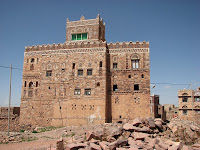
There were several open cisterns that fill up with the monsoon rains in the summer. The cistern holds the water for the whole year and was looking pretty empty.
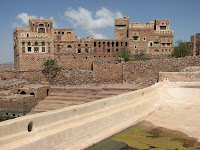
Tourists like to do treks in this area and need a guide to go from village to village.
There were very few people in the streets but young boys came from nowhere with their wheelbarrows full of souvenirs to sell. They followed us where ever we went, ever hopeful that we would buy key rings, candle holders etc.
We looked at the local tourist hotel and it had large rooms with mattresses on the floor and squat toilets.

There were several open cisterns that fill up with the monsoon rains in the summer. The cistern holds the water for the whole year and was looking pretty empty.

Tourists like to do treks in this area and need a guide to go from village to village.
 Victor and Ahmed buying a snack at the local shop.
Wadi Dhahr, Yemen

We went with the family and Asia's brother in his taxi to see the Rock Palace: Dar-al Hajar. It is about 30 minutes outside San'a. The palace as built as a summer residence for Imam Yahya in the 1920s. It is a huge structure made of red and white stone and sits perched on a rock.

We visited on a Thursday which is the first day of the Yemeni weekend. There were several groups of school children from a private school visiting as well so they were happy to practise their English each time they passed us on the stairs!
The palace is a favourite area for weddings and the weekend is the best time for them. We saw the men from a wedding party who wanted us to take photos of the groom and his entourage. We never saw the bride. Weddings are usually celebrated with lots of gun fire.

At a lookout point near the palace we were besieged by beggars, jewelery sellers, scarf sellers, falcon owners, as well as a 15 year old boy with small glasses who called himself Harry Potter and spoke 6 or 7 languages so he could sell souvenirs.
 John and the falcons
On the way home we passed several plaster factories. John was keen to look at the cornices and coloured window frames that the workers cut by hand. The workers were happy to show him their products and Victor could translate for him.

Later we met a travel agent and planned a tour to Shaharah and bought a flight ticket to Sayun.
At dinner time we watched Asia making bread and cooking it in her gas oven. It was delicious. Yemen has over 40 types of bread.


San'a, Yemen
We had a good short flight with Royal Jordanian from Cairo to San'a but a long 4 hour wait at Amman airport in Jordan.


Victor told us later that some of the men at the qat house were from a tribe that recently kidnapped a couple of Dutch tourists. These guys asked Victor if he had any grievances with the government that he would like put right. If so, then they would kidnap John in order to get the government to do do something about the grievances. Lucky for John, Victor had none.

The Al Saleh Mosque is a new mosque built by the current president at a cost of millions of dollars. It is the most beautiful mosque we have seen in the Middle East to date. Victor and his friends tell us that Yemen needs hospitals and schools and would have preferred the money was spent on that but the president wants a legacy. Mosques cannot have their names changed unlike hospitals and schools.
Near the gate of the old city we saw a blind-folded camel going round and round. It was attached to an arm like a pestle and it was grinding sesame seeds for oil. It had been walking about two hours when we saw it and it stopped for awhile and then continued. Apparently it wouldn't walk if it could see it was going in circles.

There is a river bed that is cobbled and sealed and the traffic use this everyday. When it rains once or twice a year the road becomes a river.
The men in this area wear knives attached to their belts and they pull them out at weddings and use them for dancing. Even young boys have them. Victor doesn't wear a jambiya as it is not the tradition where he comes from.
Arrived at San'a airport at 1.30 am and had to get a visa and then took a taxi we had prebooked to our hotel in the old city.
San'a is so different from any other place we have been. It the oldest city in the world, according to books we have read. Noah's son was the founder of San'a. Today it is the fastest growing capital city in the world.
The buildings are probably the first skyscrapers. They are towers. The ground floors are built of stone and the rest of the floors of mud brick. Traditionally the stables and storerooms were on the ground floor. The first floor was for entertaining. The second floor was for the women and children and the third and fourth floors were the bedrooms, bathrooms and kitchen. The top floor was the room with a view. Most towers are 6 or 8 stories.

Our hotel was a traditional building and the dining room was on the top floor. The windows are decorated with coloured glass and set in plaster and we could look over the old city. The white lime wash on the building help reflect the heat and keep the rooms cool. There are still 14, 000 original tower houses in the old city.

We contacted Victor, a Yemeni, from the Hospitality Club, an online group that offers accommodation or friendship to others in the club. He works for a Canadian oil company and has one month on and one month off. Our request to stay with him and his family arrived on his month off so after recovering from our flight at the hotel we were picked up by Victor and Asia and their two children, Ahmed (7) and Noor(5).

We had a great time with the family, with Asia cooking some delicious Yemeni food and Victor introducing John to the ways of life for Yemeni men.

Yemenis are traditional Muslims and Asia has to wear black covering her head, arms and legs with a veil across her face. She kept her head covered the whole time John was in the house but was uncovered if I was there with her. We went shopping one afternoon with the children and the men went to chew qat. The shopping centre had only women shoppers.
Qat or Khat, are the leaves of the Catha edulis shrub. It has the ability to slow down time. The WHO classes it as a drug of abuse that can produce mild to moderate psychic dependence, and is banned in most Arab and Western countries. About 80% of the Yemeni male population chew qat regularly. The towers beside each plantation are to house the guards that keep watch over the trees.

John and Victor went to a stylish Yemeni house where they sat in a room furnished with squabs on the floor and upholstered cushions against the walls. There were bolstered arm rests between each person and the men sat around the sides of the room. There was a large TV screen and the men drank water, soft drinks, smoked and chatted. About 50 people came and went between the 4pm to 8pm session. There were several professional people and John talked to men from insurance, an IT analyst for the military, engineers, and other government workers. It is a time to talk politics and right the wrongs of the world.
Victor told us later that some of the men at the qat house were from a tribe that recently kidnapped a couple of Dutch tourists. These guys asked Victor if he had any grievances with the government that he would like put right. If so, then they would kidnap John in order to get the government to do do something about the grievances. Lucky for John, Victor had none.
Environmentally, qat is bad news for Yemen. 55% of all the water in Yemen goes to irrigate the crops. In 1970, 8,000 hectares was used for qat but has now grown to 103,000 hectares and there are still new areas being developed. The profit is 5 times better for qat growers than for crop farmers. When you walk through the old city after lunch you see all the stall holders with huge bulges in their cheeks as they stuff the qat in. Young boys also get into qat chewing at an early age. Some women chew qat as well but not as much nor as often as the men. 17% of the average family's income goes on qat with over 14,622,000 working hours lost each day in Yemen, as men set aside chewing time.
Ahmet and Noor were very quick to pick up new words in English and try them out. We made origami boxes, played string games and 'paper, scissors and rock'. I helped Asia with her English lessons. She goes to a language school two hours every day and was shy at first to speak but is doing really well. We met Victor's mum and a couple of brother as well as Asia's brother who drove us in his taxi.

Near the gate of the old city we saw a blind-folded camel going round and round. It was attached to an arm like a pestle and it was grinding sesame seeds for oil. It had been walking about two hours when we saw it and it stopped for awhile and then continued. Apparently it wouldn't walk if it could see it was going in circles.

There is a river bed that is cobbled and sealed and the traffic use this everyday. When it rains once or twice a year the road becomes a river.
The men in this area wear knives attached to their belts and they pull them out at weddings and use them for dancing. Even young boys have them. Victor doesn't wear a jambiya as it is not the tradition where he comes from.
Wednesday, April 22, 2009
Cairo, Egypt
The night train to Cairo was pretty good. Kerri and I didn't sleep that well though as the beds squeaked. There was a handbasin in the room and only two beds so John had to share with a guy next door who was a tour guide. We had an early morning wake up and a basic breakfast.
Buying the ticket for the train was hard work. The tourist information officer at the station right beside the ticket office had no idea what times the trains went and insisted that we could only buy a ticket at 8pm for the 8.30pm train! We went to her as there were big queues at the ticket office. The ticket office clerk sold us a ticket for the next day 5 minutes later. I guess the tip is, keep asking until you get the right answers to your questions!
We took the metro from the station, which wasn't there 32 years ago, to Talaat Harb where our hostel was and were able to check in straight away and have a catch up sleep. We managed to sleep through the traffic noise from the second most popular downtown street in Cairo. At times it felt like the traffic was outside the window even though we were 5 flights up.
Kerri checked the temperatures for the upcoming days and with the hottest day being the next day we decided it was best to go to the National Museum and leave the pyramids for a cooler 21 degree day.
The museum used to be dark, dusty and absolutely crammed full of exhibits and rocks so I was surprised to see that we could move easily around the rooms. However it was still dark and had the same dirty typewritten labels that were there when I last visited. A new museum is due to open in 2010 out near the pyramids but it looks like there is not enough money for that yet.
The Tutankhamen treasures used to be in a room called the gold room but now they are in an open space for all to see at no extra charge so that was great.

The hostel offered us a tour to the pyramids but we took a local bus from the bus station to the entrance to the site. The touts rushed out to get us to hire horses and camels but we knew it was possible to walk around without too much trouble. I still had my blisters from camel riding in Jordan so the last thing I wanted was more of them.
 Postcard and plastic pyramid seller
32 years ago, I and a bunch of friends from the YMCA where I stayed then, climbed the top of Cheops and watched the sunset and slept overnight and woke to watch the sun rise. Now it is not possible to climb any of the pyramids. Of course we paid a baksheesh back then to be able to do it.
The poor Sphinx is looking worse for wear and our guide book tells us that it has the equivalent of cancer. It is disintegrating from the inside out due to the high water table and breakdown of the sandstone. There is now a huge wall around it.

Kerri wanted to buy some scarves and a new bag so we spent some time at the Khan Al Khalili (bazaar). She seemed to enjoy her attempts at bargaining for her purchases but we found that they were not so keen on dropping prices, even when we waved the money around or walked off. Maybe this is because of the recession.
 The scarf seller and his boys learning the trade
Crossing Cairo streets is a chore. The drivers do not like to stop for anyone and they are pretty intimidating. After half a day's practice, we were experts and Kerri got better at it too. The traffic in Vietnam is a lot more considerate than in Cairo, they moved around behind you as soon as they saw you begin to cross. The place to meet the Cairo hustlers is at Tahrir Square. they will find you as you gingerly cross the road. they usually begin their spiel with' Walk like an Egyptian, just close your eyes' or something like that. They then move quickly onto 'What's your name? Where are you from? There's a shopping centre there.'
Before you know it they are trying to hustle something as they will get a sales commission.
 This scene hasn't changed!
Some Egyptian scams we encountered:
the bus driver sells you a ticket and at the end of the trip he asks for it back so he can resell it,
tourist police at the pyramids take baksheesh off the boys selling postcards at the pyramids,
taxi touts charge double for the taxi that they don't own or drive,
tourists at the mosque have to hand in their shoes, wear a galebeya, and then pay a baksheesh to get the shoes back, while locals carry theirs inside and are dressed as you are,

two people have to share one seat on the tour bus and everyone pays different prices for the same thing,
the bus driver is having lunch so you must take a taxi,
there is a big demonstration at the Arab League building near the museum so don't go there, come with me, I don't own a shop I don't sell tours ... I know the guys who have horses and camels at the pyramids as we grew up together etc,
Oh lady you look hot and tired here sit on my seat in the shade...baksheesh please, from the tourist police or security,
I found this hotel for you so you so you owe me 30% commission.
Phew, you have to have your wits about you all the time. People who speak to you and help you usually want something other than altruism for it.
We wanted to walk beside the Nile but found that all the nice parks charge a fee and if you wanted to be on the lower part close to the Nile you had to pay more, which was probably to keep the riffraff out.
We found a couple of nice places to eat Egyptian food near our hotel. One place did only one dish called koushari and you could get it in small, medium or large. It was great for carbo-loading: macaroni, spaghetti, rice, lentils and a tomato sauce. There was also creamed rice if you needed more carbos.
The other place had its kitchen in the front on the street level, so you could see the pizzas, pancakes, shwarma, and kebabs being made. The upstairs had long tables that seated 10 or 12 people and had a good selection of sandwiches, soups, salads, grills, fish, and pasta dishes. The menu was in English and Arabic and it was a popular place for families and young couples.
The street we stayed on had hundreds of clothing shops. We found a department store that had 7 or 8 floors and thought we might find something for Kerri only to discover that every floor had mens' clothes and we only saw one store with womens' clothes. There are dozens of children"s shops with doll-like mannequins dressed in sequined, frilled and over decorated co-ordinated outfits. Some even had Madonna type sequined bra tops for under 5 year olds.
The lingerie shops are amazing. The couples stand outside discussing, and pointing at the see-through negligees and skimpy underwear and we would only have such clothes in an adult shop.

We took Kerri to the airport on her last day and spent another couple of days catching up with the blog, sending emails, doing some research on Yemen and getting ready to go to more Middle Eastern places. It was sad to see her go but we will be home before too long.
Subscribe to:
Posts (Atom)